
Product Roadmap and Innovation at Deutsche Aircraft
Innovation inspires us every day at Deutsche Aircraft. Our Product Roadmap and Innovation team conceptualises and develops aircraft for the future, with a focus on continuous improvement and the smart integration of emerging technologies.
contact us3
Publicly funded R&D
programmes
9+
Partners across
industry, academia &
government
4
Active innovation
projects
1
Dedicated live flight test aircraft
Public Funded
Innovation Projects
In addition to our internal research and development activities, Deutsche Aircraft is an active collaborator in several publicly funded innovation projects. Through partnerships with industrial, academic and governmental organisations, we are accelerating technological progress and strengthening the European aviation ecosystem. These projects are fundamental for maturing breakthrough technologies and accelerating their transition from research to real-world applications.
Continuous Innovation in Action
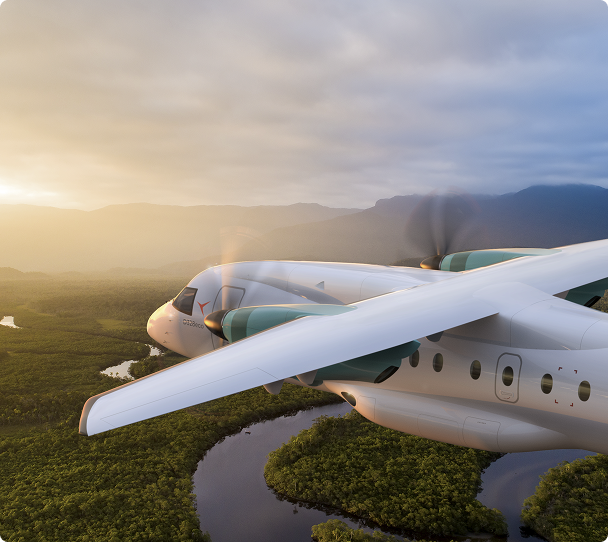
The D328eco® is the most innovative and fuel-efficient regional turboprop in its class. Driving this progress is an international, multidisciplinary team dedicated to the evolution of the D328eco platform, while simultaneously pioneering the technologies of tomorrow.
From next-generation digital tools and lightweight materials to advanced electrical systems, fuel-efficiency solutions and elevated standards for passenger comfort, we are constantly enhancing the capabilities of our design. By setting new benchmarks in performance and environmental responsibility, we deliver future-ready innovations to operators, governments and communities.
Our Mission: Climate-Neutral Aviation
A central element of our mission is to support the transition to climate-neutral aviation. Our team is committed to investigating new aircraft concepts and low- or zero-emission propulsion technologies that support the industry’s path toward sustainability.
True innovation thrives on a global perspective. Deutsche Aircraft collaborates with leading technology partners across Germany, Europe and around the world to accelerate the development of cutting-edge aerospace solutions. These alliances provide access to world-class expertise and resources, empowering us to bring future-forward technologies to market with greater agility.
Collaborating for Impact
True innovation thrives on a global perspective. Deutsche Aircraft collaborates with leading technology partners across Germany, Europe and around the world to accelerate the development of cutting-edge aerospace solutions.These alliances provide access to world-class expertise and resources, empowering us to bring future-forward technologies to market with greater agility.

UpLift Test Demonstrator: D-CUPL
Project Profile
Objective
Converting the Dornier 328 into a flying test laboratory for climate-friendly aviation technologies. The aircraft will be used as a flying testbed by research institutions and industrial companies to test and validate the potential of promising new technologies under real-world flight conditions.
Partners
Deutsche Aircraft, German Aerospace Centre, Sasol, Pratt & Whitney Canada.
Test Platform
UpLift D328 test demonstrator (D-CUPL).
The UpLift project is an integral part of the German Federal Government’s aeronautics research programme, providing the aviation industry with a unique flying laboratory. Designed as an open-technology platform, UpLift enables the testing of breakthrough innovations — such as hydrogen propulsion, fully synthetic fuels and advanced sensor systems — whose climate impact will be measured and quantified in flight. By bridging the gap between research and real-world application, this platform significantly accelerates the market entry of future-forward technologies.
As a beacon of innovation, the D328 UpLift enables the aeronautics industry, SMEs and start-ups to pave the way for a new generation of aircraft by testing new engines, energy systems and integration concepts under real flight conditions.
Development Roadmap
The path to climate-friendly air transport requires a precise understanding of the climate impact of the various propulsion concepts under different operating conditions.
The world’s first ground-based emission measurements of a turboprop aircraft powered by aromatic-free PtL proxy fuel took place in September 2024. This was followed by a series of successful emission and contrail measurement flights in late 2025, using fully synthetic Fischer-Tropsch fuel.
A successful Ground Vibration Test (GVT) was also completed in August 2025 to validate structural dynamics and refine the numerical models used in flutter analysis and load calculation. By quantifying the climate impact of these innovations, the project provides the data necessary to support the industry’s transition towards zero-carbon regional aviation.



.png)
Partner
Deutsches Zentrum für Luft-
und Raumfahrt e.V.
.png)
Scope
Project leader and aircraft operator
Management of flight experiments
Scientific evaluation
Partner
Deutsche Aircraft GmbH
Scope
Aircraft manufacturer
Structural modifications, maintenance and technical certifications
Requirements definition and validation in real-world aircraft design workflows
Partner
Sasol
Scope
Strategic partner for sustainable fuels
Provision and research of 100% Power-to-Liquid kerosene
Partner
Pratt & Whitney Canada
Scope
Provision of expertise and data for PW119B engines
Sustainable Performance by Ice Protection System
Project Profile
Objective
Developing energy-optimised, electrical Ice Protection Systems that combine targeted activation with advanced anti-icing coatings to lower CO2 emissions and reduce power requirements.
Partners
Deutsche Aircraft, the German Aerospace Center, TU Braunschweig, Fraunhofer IFAM.
Test Platform
Airborne validation on the UpLift D328 test aircraft (D-CUPL).
The SPICE joint research project aims to improve existing de-icing systems for turboprop aircraft by replacing them with more effective and energy-optimised electrical Ice Protection Systems (IPS). A typical turboprop aircraft with its de-icing system activated consumes around 20% more fuel (up to 40 kg of kerosene during a 30-minute hold). In addition, fuel consumption increases by up to 7.5% due to residual ice build-up after a flight in icing conditions.
The use of innovative de-icing systems activated in a targeted manner, can result in a direct saving of CO2 emissions. Anti-icing coatings, which reduce ice build-up, can reduce the required heating power by a further 90%. To ensure a targeted activation of the systems, new anti-icing systems also rely on optimised detection and precise monitoring of their effectiveness.
This collaboration between Deutsche Aircraft, the German Aerospace Centre, TU Braunschweig and Fraunhofer IFAM will develop, optimise and integrate the Ice Protection System into a representative airfoil and test it for future use in regional aviation.
Development Roadmap
The research project is planned over two
LuFo VII project phases.
Phase 1
In the first project phase (LuFo VII-1), partners will specify system requirements based on typical flight and icing conditions. Water droplet impingement limits on aircraft surfaces will be analysed to characterise and predict the expected ice shapes and their effects on the aircraft’s flight characteristics and performance. Ice-phobic materials will also be assessed for their ability to complement an active ice protection system.As the project progresses, the analytical results, including (super-)hydrophobic surfaces, will be evaluated in an icing wind tunnel. The tests will consider the erosion of different wing surfaces and different ice types, including glaze, rime and runback. Ice accretion simulations will be performed with and without the IPS to estimate the effects on overall energy savings, efficiency and performance benefits, and these results will be validated in an icing wind-tunnel test campaign. In addition, the project will address icing detection methods that can enable more targeted activation of ice-protection countermeasures, further reducing energy consumption.
Phase 2
In the second phase, a test flight and validation of the developed technologies will take place on the UpLift D328 flying testbed (D-CUPL).


Partner
Deutsches Zentrum für Luft-
und Raumfahrt e.V.
Scope
Flight dynamics modelling
Flight-mechanical analysis
Assessment of flight characteristics
Performance-based icing detection
Partner
Deutsche Aircraft GmbH
Scope
Aircraft OEM
Airborne Ice Protection System and aircraft system integration expertise
Aircraft-specific and operational requirements and use cases
Partner
Fraunhofer IFAM
Scope
Specification of Ice-phobic coatings and innovative materials
Assessment and tests against operational and integration requirements
Partner
Technische Universität Berlin
Scope
Ice-shapes prediction
Aerodynamic airfoil analysis
On-site icing wind-tunnel testing
Results analysis
Multiscale System-Oriented Design of a Fuel-Cell Powered Regional Aircraft
Project Profile
Objective
Developing a multiscale, system-oriented digital simulation environment to evaluate novel hydrogen fuel-cell propulsion architectures during the earliest stages of aircraft design.
Partners
Deutsche Aircraft, AVL.
Test Platform
Multiscale Digital Simulation Environment (integrating Desmo and AVL CRUISE™ M platforms).
To meet ambitious targets to achieve net-zero CO₂ emissions by 2050, the aviation industry requires a fundamental shift in how we power regional aircraft. Hydrogen-based fuel-cell systems are a primary candidate for this transformation, offering the potential to reduce CO₂ by up to 100% while providing significant improvements in noise and efficiency.
The objective of the MIMOSA project (LuFo VII-1) is to provide aircraft designers with an integrated simulation environment to evaluate unconventional propulsion systems early in the development cycle. By connecting preliminary aircraft design with high-fidelity fuel-cell and thermal-management modelling, this creates a multiscale workflow for evaluating innovative zero-emission propulsion concepts before the costly design stage.
Development Roadmap
MIMOSA investigates how high-fidelity fuel-cell simulation tools, such as AVL CRUISE M can be integrated with the Desmo preliminary design platform to exploit synergies between component-level and aircraft-level modelling.
Custom interfaces will enable structured data exchange at the resolution required for multiscale simulation to ensure a seamless connection from individual components to the behaviour of the complete aircraft.
MIMOSA allows engineers to efficiently narrow the design space, avoid unpromising configurations early and evaluate multiple system architectures to identify the best-performing concepts.
Using this integrated approach, MIMOSA supports faster and better-informed design decisions, optimised fuel-cell propulsion architectures and a strong foundation for the transition to zero-carbon regional aviation.
.png)

Partner
Deutsche Aircraft GmbH
Scope
OEM integration
Requirements definition, and validation in real-world aircraft design workflows
Partner
Technische Universität Berlin
Scope
Aircraft design
Partner
PACE Aerospace Engineering and Information Technology GmbH
Scope
Overall aircraft and systems simulation
Partner
AVL Deutschland GmbH
Scope
High-fidelity fuel-cell and thermal-management modelling
Next Generation Fly-by-Wire for Regional Aircraft
Project Profile
Objective
A modular, cost-optimised and high-efficiency Fly-by-Wire architecture for the regional segment.
Partners
Deutsche Aircraft, Liebherr-Aerospace, German Aerospace Center, TU Berlin.
Test Platform
UpLift D328 test demonstrator (D-CUPL).
The NewFlair joint research project is pioneering an efficient, cost-optimised and modular Fly-by-Wire (FBW) flight control system with new architectures and components for future regional aircraft.
Deutsche Aircraft (DA) is collaborating with Liebherr (LLI), the German Aerospace Centre (DLR) and TU Berlin (TUB) to spearhead these advancements.
Development Roadmap
The overall development is planned across
the three LuFo VII project phases.
Phase 1
In the first phase (LuFo VII-1), FBW concept trades will be carried out, overall system simulations created for validation and hardware-in-the-loop (HiL) validations performed for individual components.This will evaluate different FBW architectures for regional aircraft in terms of feasibility, development effort and cost.
Phase 2
In the second phase, selected parts of the overall system will be implemented in hardware and put into operation in ground tests.
Phase 3
The third phase will involve the integration of selected elements into the D-CUPL flight test aircraft, including final testing and validation of the developed technologies.
Requirements for the FBW system will be derived from aircraft-level specifications. Based on these requirements, we will develop high-level architecture and technology trades, studies on the Flight Control Laws (FCL) philosophy, and concepts for the control units.
Other key considerations include computer architecture, power supply concepts, actuator integration, space allocation, system cost, reliability, robustness, weight and upgrade capability.

Partner
Deutsches Zentrum für Luft-
und Raumfahrt e.V.
Scope
Test rig preparation for ground tests
Overall simulation of the flight control system
Design and implementation of the flight control laws including associated protective functions, evaluation of the flight characteristics of the flight control laws in the context of pilot-in-the-loop simulations, torque-based flight control, torque control of electromechanical rudder actuators, integration, operation and safety concept
Partner
Deutsche Aircraft GmbH
Scope
Design of the overall architecture for FCS, sensor technologies, air data systems and control laws
Definition of requirements for the FBW system including a test and certification strategy
Partner
Liebherr-Aerospace Lindenberg GmbH
Scope
Consortium management
Development of an FBW system and the necessary technology modules, actuators and individual technologies
Associated component tests and analysis of the overall FBW system developed for a future regional aircraft
Partner
Technische Universität Berlin
Scope
Development of acceleration-based control laws for flight dynamics and actuators
Development of an independent monitoring function for the flight control laws
Implementation of the functions developed by TUB in the institute's own research simulator
Performance of pilot tests to evaluate the new functions.
March 6, 2026
Project MIMOSA
True innovation thrives on a global perspective. Deutsche Aircraft collaborates with leading technology partners across Germany, Europe and around the world to accelerate the development of cutting-edge aerospace solutions.
These alliances provide access to world-class expertise and resources, empowering us to bring future-forward technologies to market with greater agility.
.avif)


