Above & Beyond: The Women Engineering the Future of Regional Aviation at Deutsche Aircraft

True innovation lives at the intersection of diverse perspectives, yet women remain vastly underrepresented in aerospace. Women Of Aviation Worldwide Week serves as a global call to action to address this gender imbalance, honouring the spirit of Raymonde de Laroche, who became the first woman to earn a pilot’s licence on 8 March 1910. 

From 2-8 March 2026, the aviation community will celebrate the theme, “Above & Beyond: Challenging Expectations” – a sentiment reflected daily in the work of the women at Deutsche Aircraft. During this week, the Institute for Women Of Aviation Worldwide, schools and businesses continue the mission of propelling change in our hangars, cockpits and boardrooms by amplifying the visibility of female aviators and hosting events to engage the next generation.

With girls still three times less likely than boys to pursue a career in aviation, initiatives like the Fly It Forward challenge are crucial. By offering thousands of girls the life-changing opportunity to fly in small aircraft, these programs ignite the passion necessary to open doors in the aerospace industry.

Why Are Women Underrepresented in Aviation? 

The aviation gender gap is a systemic relic. While women are more likely than men to pursue higher education, they still only account for 35% of STEM graduates globally.  While women comprise 41% of the science and engineering workforce in Europe, they hold only 18.8% of technical manufacturing roles in aviation, highlighting a clear disparity. And although Europe leads the world in female pilots, the figure remains at a stagnant 6%. This gap is even more critical as we move toward digital transformation, with women representing just 26% of the workforce in Data and Artificial Intelligence, and a mere 12% in Cloud Computing.

To dismantle the aviation career barriers that discourage talented women from entering or staying in the field, we must understand the inequities holding them back:

  • The Visibility Gap: Without female role models in leadership and engineering, a career in aviation can feel isolated or unattainable. Representation is fundamental.
  • Societal Stereotypes: Long-standing cultural narratives have historically framed STEM and aerospace as male domains, creating a confidence gap for girls before they even enter university.
  • Institutional Friction: Many qualified women leave the industry due to a lack of mentorship or rigid structures that don’t accommodate real-life responsibilities.
  • Economic Barriers: The high cost of pilot training and historical gender bias in research funding create a steep climb for women considering a career in flight.

As UN Secretary-General António Guterres recently noted, “Equality in the sciences is essential for humanity’s progress. Excluding women from science weakens our collective capacity to solve urgent challenges [like] climate change . . . The absence of female voices, especially in leadership positions, embeds biases and leads to real world harm.”

Challenging Expectations: The Women at Deutsche Aircraft

Women of Aviation Worldwide Week is about moving from awareness to action. At Deutsche Aircraft, we believe that diversity is critical to innovation. When women lead in STEM, they bring essential insights and approaches needed to design smarter, more sustainable aircraft. 

Diversity creates resilience. Diverse teams ask different questions about safety, ethics and design – identifying unique solutions to the most complex problems. 

The women at Deutsche Aircraft are the architects of an increasingly inclusive aviation future. Here’s how they are answering some of the industry’s biggest questions during Women Of Aviation Week.

Why is Diversity Essential for Innovation in Aviation? 

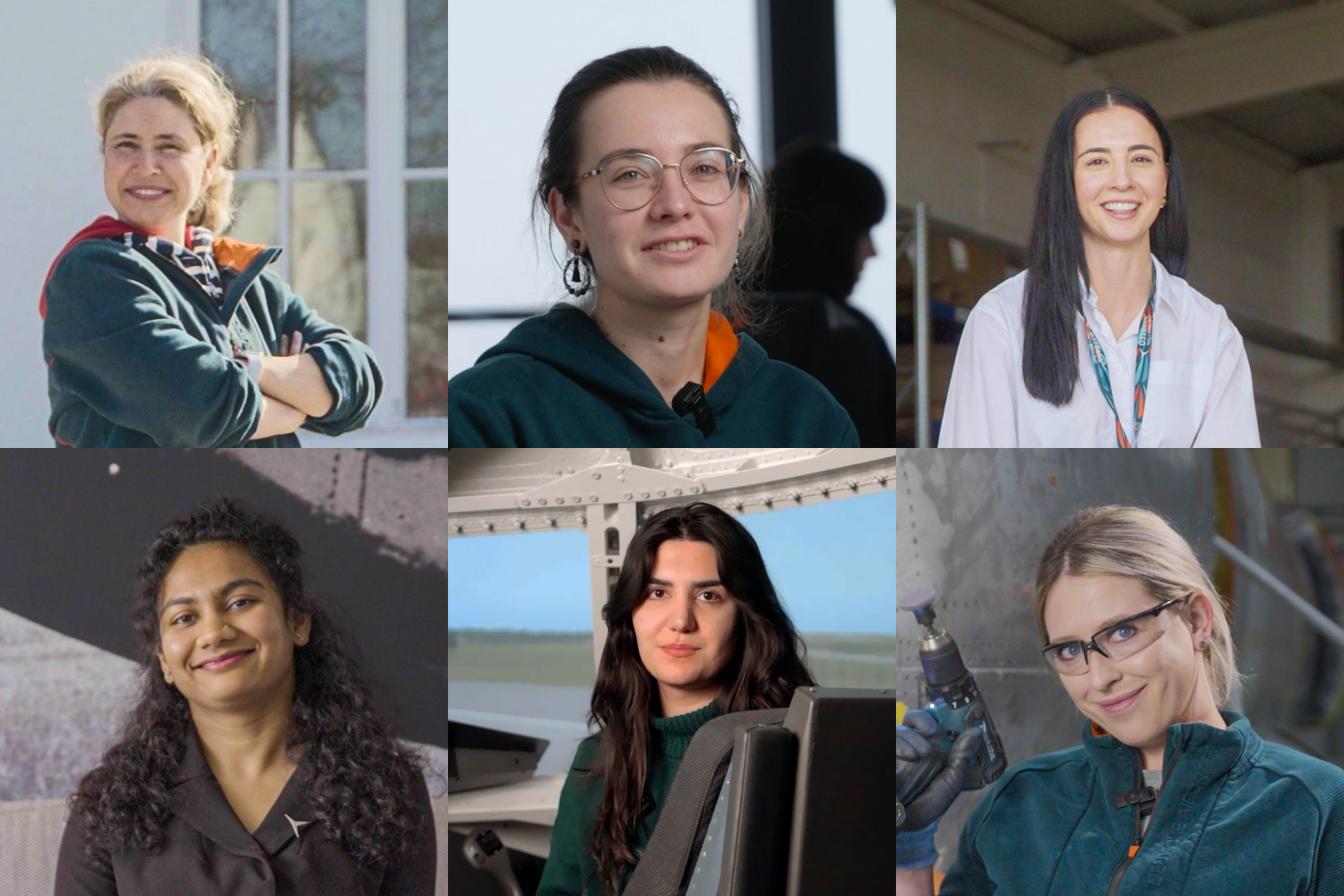
As Chief Commercial Officer of Deutsche Aircraft, Anastasija Visnakova is a leading voice for the next generation of women in regional aviation. 

“What really gives us benefits is cognitive diversity,” she observes. “We need to have people of different gender, different races, different nationalities, different educational backgrounds, different cultural backgrounds, different professional careers and different experiences. Bringing all these people together gives us incredible cognitive diversity within the team, so we can benefit from their knowledge and experience. This is the diversity that I believe in.” 

While the industry is increasingly open and welcoming, Anastasija acknowledges that there is still some bias. “But many women are breaking the glass ceiling,” she adds. “Organisations are making efforts to offer possibilities to women in different stages of their lives, which Deutsche Aircraft is doing perfectly.”

How is Flight Simulation Technology Closing the Gender Gap in Pilot Training?

Simulation engineering is dismantling the aviation gender gap by fundamentally shifting the accessibility, culture and design philosophy of the industry. Simulation technology enables structural flexibility and utilises virtual training to bridge the confidence gap. 

This digital frontier is being shaped by Simulation Engineers like Tugce Sayir. Her role involves programming the virtual flight deck of the D328eco simulator, building the tools that will train the next generation of pilots.

Tugce’s interest in aviation began as a child spending hours watching the sky. “It always amazed me that an object can stay in the air,” she says. This curiosity defined her professional trajectory, leading her to pivot from computer engineering in Turkey to aerospace in Germany. 

Even in a sector with historically narrow representation, she views her role as a catalyst for change. “The field is male-dominated, but that will not change unless you make your presence shown,” she says.

How are Women Driving the Transition to Net-Zero Aviation? 

Enora Saule is at the forefront of the net-zero mission, ensuring that the D328eco is sustainable through material science. As a Development Engineer for Materials & Processes, Enora ensures every coating and sealant used on the D328eco airframe meets technical requirements. Her work also includes developing advanced materials that comply with strict environmental regulations. 

Enora views the climate crisis as a unique opening for the next generation. “We're at a time when this industry needs to reinvent itself. It’s a good opportunity for young engineers to make a mark.”

For those following in her footsteps, her advice is centred on risk-taking and resilience. “Getting out of your comfort zone means that you’re constantly growing. Resilience is important because you will encounter things that don’t work, or pushback. Not giving up and pushing to get things completed really make a difference.”

Why is There a Critical Need for Female Aircraft Technicians?

A growing workforce of female maintenance technicians is instrumental in addressing the global labour shortage in aviation and introducing different problem-solving approaches. However, one of the most persistent career barriers remains the outdated perception that technical trades are a male domain. 

Aircraft Mechanic Viktoria Gnäd is dismantling that myth on the hangar floor at Deutsche Aircraft. Part of a specialised team ensuring the airworthiness of our legacy fleet, her role requires a combination of deep theoretical knowledge and physical precision. 

For Viktoria, the pride in her work comes from the rarity of her position and the tangible satisfaction of working with her hands. "What makes me especially proud is that there aren't many women in this profession,” she says. 

Her advice to the next generation of engineers? “To every young girl: do not be afraid. Just do it.”

How to Navigate Your Aviation Career: 6 Essential Insights for Women

Is aviation a good career for women? 

There has never been a better time for women to enter aviation. The industry offers diverse career paths, from engineering and data science to mechanics and flight operations. With the industry’s shift toward sustainability and digitalisation, there is a high demand for specialised skills and fresh perspectives. 

How can I become an aircraft mechanic?

In Germany, the most common path is through a vocational training program called Ausbildung. This work-study model allows trainees to earn a salary while gaining hands-on experience and a recognised qualification. The dual system combining practical experience and theoretical knowledge often leads to direct entry into the workforce. 

How can I start my career in aviation? 

Usually, a degree in Aeronautical Engineering, Mechanical Engineering or Computer Science is the standard entry point. Interdisciplinary backgrounds and specialised fields like Material Science or Environmental Engineering are also in high demand. Companies like Deutsche Aircraft are looking for passionate problem-solvers committed to achieving net-zero aviation.

What is the biggest barrier for women in aerospace? 

A lack of visible role models, structural inequities and societal stereotypes remain the most common obstacles for women in aviation today. To challenge this status quo, WOAW actively celebrates female aviation leaders, offers mentorship programs and promotes Fly It Forward initiatives to introduce girls to aviation from an early age.

Can I work in aviation if I don’t want to be a pilot or an engineer?

Absolutely. Aviation requires the full spectrum of female talent, including Strategic Procurement experts to build sustainable supply chains, Compliance specialists to navigate aviation law and Communications professionals to tell our story. From Human Resources to Project Management, every role on the ground is essential to getting aircraft in the air.

What does "work-life balance" look like for a woman in aviation?

While companies like Deutsche Aircraft offer flexible working models and mentorship for women, navigating work-life balance requires a high degree of adaptability and resilience. 

“Being a woman, being a mother – it’s not easy,” says Anastasija Visnakova. “I don't believe in a work-life balance, as such. I think it’s kind of a cliche. You have to be agile enough to understand that you will not have perfect days where life and work are balanced. So you go with the flow, you do whatever it takes, you do your best.”

Your Place to Lift Off: Join #TeamDA

The future of regional aviation is being built today at Deutsche Aircraft. Whether you are a student looking for an earn-while-you-learn opportunity or an experienced professional ready for a new challenge, we offer a dynamic environment where your career can truly take flight.

We are currently undergoing an exciting expansion with our Final Assembly Line in Leipzig, creating up to 350 new jobs in one of Germany’s most vibrant aviation hubs. This facility represents the future of climate-friendly production and we are actively seeking candidates for a variety of roles, from Ausbildung aviation apprenticeships to systems engineers. 

Ready to make your mark? We need female talent to lead the way in challenging expectations and building a more inclusive future for regional aviation.

Explore your next career opportunity at Deutsche Aircraft.

For media enquiries, please contact pressoffice@deutscheaircraft.com

No items found.

Building the future of flight

Above & Beyond: The Women Engineering the Future of Regional Aviation at Deutsche Aircraft
March 5, 2026
Above & Beyond: The Women Engineering the Future of Regional Aviation at Deutsche Aircraft

True innovation lives at the intersection of diverse perspectives, yet women remain vastly underrepresented in aerospace. Women Of Aviation Worldwide Week serves as a global call to action to address this gender imbalance, honouring the spirit of Raymonde de Laroche, who became the first woman to earn a pilot’s licence on 8 March 1910. 

From 2-8 March 2026, the aviation community will celebrate the theme, “Above & Beyond: Challenging Expectations” – a sentiment reflected daily in the work of the women at Deutsche Aircraft. During this week, the Institute for Women Of Aviation Worldwide, schools and businesses continue the mission of propelling change in our hangars, cockpits and boardrooms by amplifying the visibility of female aviators and hosting events to engage the next generation.

With girls still three times less likely than boys to pursue a career in aviation, initiatives like the Fly It Forward challenge are crucial. By offering thousands of girls the life-changing opportunity to fly in small aircraft, these programs ignite the passion necessary to open doors in the aerospace industry.

Why Are Women Underrepresented in Aviation? 

The aviation gender gap is a systemic relic. While women are more likely than men to pursue higher education, they still only account for 35% of STEM graduates globally.  While women comprise 41% of the science and engineering workforce in Europe, they hold only 18.8% of technical manufacturing roles in aviation, highlighting a clear disparity. And although Europe leads the world in female pilots, the figure remains at a stagnant 6%. This gap is even more critical as we move toward digital transformation, with women representing just 26% of the workforce in Data and Artificial Intelligence, and a mere 12% in Cloud Computing.

To dismantle the aviation career barriers that discourage talented women from entering or staying in the field, we must understand the inequities holding them back:

  • The Visibility Gap: Without female role models in leadership and engineering, a career in aviation can feel isolated or unattainable. Representation is fundamental.
  • Societal Stereotypes: Long-standing cultural narratives have historically framed STEM and aerospace as male domains, creating a confidence gap for girls before they even enter university.
  • Institutional Friction: Many qualified women leave the industry due to a lack of mentorship or rigid structures that don’t accommodate real-life responsibilities.
  • Economic Barriers: The high cost of pilot training and historical gender bias in research funding create a steep climb for women considering a career in flight.

As UN Secretary-General António Guterres recently noted, “Equality in the sciences is essential for humanity’s progress. Excluding women from science weakens our collective capacity to solve urgent challenges [like] climate change . . . The absence of female voices, especially in leadership positions, embeds biases and leads to real world harm.”

Challenging Expectations: The Women at Deutsche Aircraft

Women of Aviation Worldwide Week is about moving from awareness to action. At Deutsche Aircraft, we believe that diversity is critical to innovation. When women lead in STEM, they bring essential insights and approaches needed to design smarter, more sustainable aircraft. 

Diversity creates resilience. Diverse teams ask different questions about safety, ethics and design – identifying unique solutions to the most complex problems. 

The women at Deutsche Aircraft are the architects of an increasingly inclusive aviation future. Here’s how they are answering some of the industry’s biggest questions during Women Of Aviation Week.

Why is Diversity Essential for Innovation in Aviation? 

As Chief Commercial Officer of Deutsche Aircraft, Anastasija Visnakova is a leading voice for the next generation of women in regional aviation. 

“What really gives us benefits is cognitive diversity,” she observes. “We need to have people of different gender, different races, different nationalities, different educational backgrounds, different cultural backgrounds, different professional careers and different experiences. Bringing all these people together gives us incredible cognitive diversity within the team, so we can benefit from their knowledge and experience. This is the diversity that I believe in.” 

While the industry is increasingly open and welcoming, Anastasija acknowledges that there is still some bias. “But many women are breaking the glass ceiling,” she adds. “Organisations are making efforts to offer possibilities to women in different stages of their lives, which Deutsche Aircraft is doing perfectly.”

How is Flight Simulation Technology Closing the Gender Gap in Pilot Training?

Simulation engineering is dismantling the aviation gender gap by fundamentally shifting the accessibility, culture and design philosophy of the industry. Simulation technology enables structural flexibility and utilises virtual training to bridge the confidence gap. 

This digital frontier is being shaped by Simulation Engineers like Tugce Sayir. Her role involves programming the virtual flight deck of the D328eco simulator, building the tools that will train the next generation of pilots.

Tugce’s interest in aviation began as a child spending hours watching the sky. “It always amazed me that an object can stay in the air,” she says. This curiosity defined her professional trajectory, leading her to pivot from computer engineering in Turkey to aerospace in Germany. 

Even in a sector with historically narrow representation, she views her role as a catalyst for change. “The field is male-dominated, but that will not change unless you make your presence shown,” she says.

How are Women Driving the Transition to Net-Zero Aviation? 

Enora Saule is at the forefront of the net-zero mission, ensuring that the D328eco is sustainable through material science. As a Development Engineer for Materials & Processes, Enora ensures every coating and sealant used on the D328eco airframe meets technical requirements. Her work also includes developing advanced materials that comply with strict environmental regulations. 

Enora views the climate crisis as a unique opening for the next generation. “We're at a time when this industry needs to reinvent itself. It’s a good opportunity for young engineers to make a mark.”

For those following in her footsteps, her advice is centred on risk-taking and resilience. “Getting out of your comfort zone means that you’re constantly growing. Resilience is important because you will encounter things that don’t work, or pushback. Not giving up and pushing to get things completed really make a difference.”

Why is There a Critical Need for Female Aircraft Technicians?

A growing workforce of female maintenance technicians is instrumental in addressing the global labour shortage in aviation and introducing different problem-solving approaches. However, one of the most persistent career barriers remains the outdated perception that technical trades are a male domain. 

Aircraft Mechanic Viktoria Gnäd is dismantling that myth on the hangar floor at Deutsche Aircraft. Part of a specialised team ensuring the airworthiness of our legacy fleet, her role requires a combination of deep theoretical knowledge and physical precision. 

For Viktoria, the pride in her work comes from the rarity of her position and the tangible satisfaction of working with her hands. "What makes me especially proud is that there aren't many women in this profession,” she says. 

Her advice to the next generation of engineers? “To every young girl: do not be afraid. Just do it.”

How to Navigate Your Aviation Career: 6 Essential Insights for Women

Is aviation a good career for women? 

There has never been a better time for women to enter aviation. The industry offers diverse career paths, from engineering and data science to mechanics and flight operations. With the industry’s shift toward sustainability and digitalisation, there is a high demand for specialised skills and fresh perspectives. 

How can I become an aircraft mechanic?

In Germany, the most common path is through a vocational training program called Ausbildung. This work-study model allows trainees to earn a salary while gaining hands-on experience and a recognised qualification. The dual system combining practical experience and theoretical knowledge often leads to direct entry into the workforce. 

How can I start my career in aviation? 

Usually, a degree in Aeronautical Engineering, Mechanical Engineering or Computer Science is the standard entry point. Interdisciplinary backgrounds and specialised fields like Material Science or Environmental Engineering are also in high demand. Companies like Deutsche Aircraft are looking for passionate problem-solvers committed to achieving net-zero aviation.

What is the biggest barrier for women in aerospace? 

A lack of visible role models, structural inequities and societal stereotypes remain the most common obstacles for women in aviation today. To challenge this status quo, WOAW actively celebrates female aviation leaders, offers mentorship programs and promotes Fly It Forward initiatives to introduce girls to aviation from an early age.

Can I work in aviation if I don’t want to be a pilot or an engineer?

Absolutely. Aviation requires the full spectrum of female talent, including Strategic Procurement experts to build sustainable supply chains, Compliance specialists to navigate aviation law and Communications professionals to tell our story. From Human Resources to Project Management, every role on the ground is essential to getting aircraft in the air.

What does "work-life balance" look like for a woman in aviation?

While companies like Deutsche Aircraft offer flexible working models and mentorship for women, navigating work-life balance requires a high degree of adaptability and resilience. 

“Being a woman, being a mother – it’s not easy,” says Anastasija Visnakova. “I don't believe in a work-life balance, as such. I think it’s kind of a cliche. You have to be agile enough to understand that you will not have perfect days where life and work are balanced. So you go with the flow, you do whatever it takes, you do your best.”

Your Place to Lift Off: Join #TeamDA

The future of regional aviation is being built today at Deutsche Aircraft. Whether you are a student looking for an earn-while-you-learn opportunity or an experienced professional ready for a new challenge, we offer a dynamic environment where your career can truly take flight.

We are currently undergoing an exciting expansion with our Final Assembly Line in Leipzig, creating up to 350 new jobs in one of Germany’s most vibrant aviation hubs. This facility represents the future of climate-friendly production and we are actively seeking candidates for a variety of roles, from Ausbildung aviation apprenticeships to systems engineers. 

Ready to make your mark? We need female talent to lead the way in challenging expectations and building a more inclusive future for regional aviation.

Explore your next career opportunity at Deutsche Aircraft.

About the data:
- Source: Cirium
- Schedules data: full year 2019 vs. 2020 – excludes non-scheduled flying
- In-service data:
- For 2019 the data is dated April while for 2020 it’s dated October. We wanted to compare “shoulder month” to shoulder month, however April 2020 wouldn’t have captured the immediate impact of Coronavirus as our dataset classes aircraft as in storage after 3 months of inactivity.

DA Aviation Ecosystem Review

We are proud to present, “Aviation Ecosystem Review 2020.”
Based on market research surrounding our vision of building a sustainable future for aviation, this report provides insight into how we see Deutsche Aircraft fitting into the everchanging aviation environment.

Download the report for free here.

Access Review

Welcome: New Leadership Onboard

Nico Neumann Deutsche Aircraft

Nico’s responsibilities as Vice President of Operations & Programs include development of aircraft production programs, maintenance, overall quality management and ensuring infrastructure and knowledge are in place to meet future needs.

Read more

As Director of Supply Chain, Maximilian’s role is to lead development and growth of all supply chain activities under a consolidated strategy.

Read more

DA Latest News in a Nutshell

New talent appointed to strengthen the Deutsche aircraft programme

As part of its continued support of Deutsche Aircraft’s D328eco aircraft programme, 328 Support Services GmbH recently appointed a panel of “talent experts” to further strengthen the overall team and ensure strong management structure and processes are in place across the D328eco development programme. Today we focus on the Engineering & Programme departments.

On the programme side, Mr. Peter Spyrka has been appointed Director of Programmes. Peter brings over 20 years’ experience in the global aerospace industry with engineering & development works on both civil and military aircraft programmes. Prior to joining Deutsche Aircraft, Peter worked at Airbus, leading the Hybrid Electric Propulsion System development programme for demonstrator projects. He also worked for Fairchild Dornier back in the late 1990’s.

In Engineering, Mr. Jean-Damien Mazeau has been appointed as our new Head of Propulsion Systems. Jean-Damien also brings more than 20 years’ aeronautical experience to Deutsche Aircraft, having built most of his career at Airbus. He was most recently involved with the A320neo’s entry into service, in charge of propulsion system’s global technical Support.

Last but not least, Dr. Stefan Brunner brings more than two decades of expertise and experience to his position as Head of Airframe. Throughout his career, Stefan spent more than 17 years working directly for the Airbus group where he was heavily involved with a wide variety of major engineering programmes on both commercial aviation and defence & space programmes. In his new role, Stefan will be responsible for design, analysis and modification of the D328eco airframe’s primary structure (Fuselage, Fairings, Wing, Empennage), as well as establishing new processes and procedures to complete aircraft development. Finally, he is responsible for ensuring compliance with the European Authorisation and Restriction of Chemicals (REACH) regulations.

In addition to Peter, Jean Damien and Stefan, we are also proud to announce that we have been busy hiring new talent from not only within Germany, but from all over the world. Coming from a variety of companies within the aerospace industry, we look forward to utilising our new team members’ skills and expertise to achieve the entry into service scheduled for 2025.

All are great assets to the current Engineering & Programme team and will, without a doubt, help support Deutsche Aircraft’s development programme over the coming years.

Deutsche Aircraft Aviation Ecosystem Review 2020 Download

Aviation Ecosystem Review 2020

Download the report for free here.

Thank you! A link to the report has been emailed to you.
Oops! Something went wrong while submitting the form. Please try again.
Deutsche Aircraft Aviation Ecosystem Review 2020 Download

ESG in Aviation 2022

Download the report for free here.

Thank you! A link to the report has been emailed to you.
Oops! Something went wrong while submitting the form. Please try again.